Wilhelmina Coote / Clause-by-clause editor
100 free spins on top of a 150% match
The first crypto deposit at the casino is matched by 150% up to 1.5 BTC and comes with 100 free spins. Crypto in, bonus on top; 18+, terms apply.
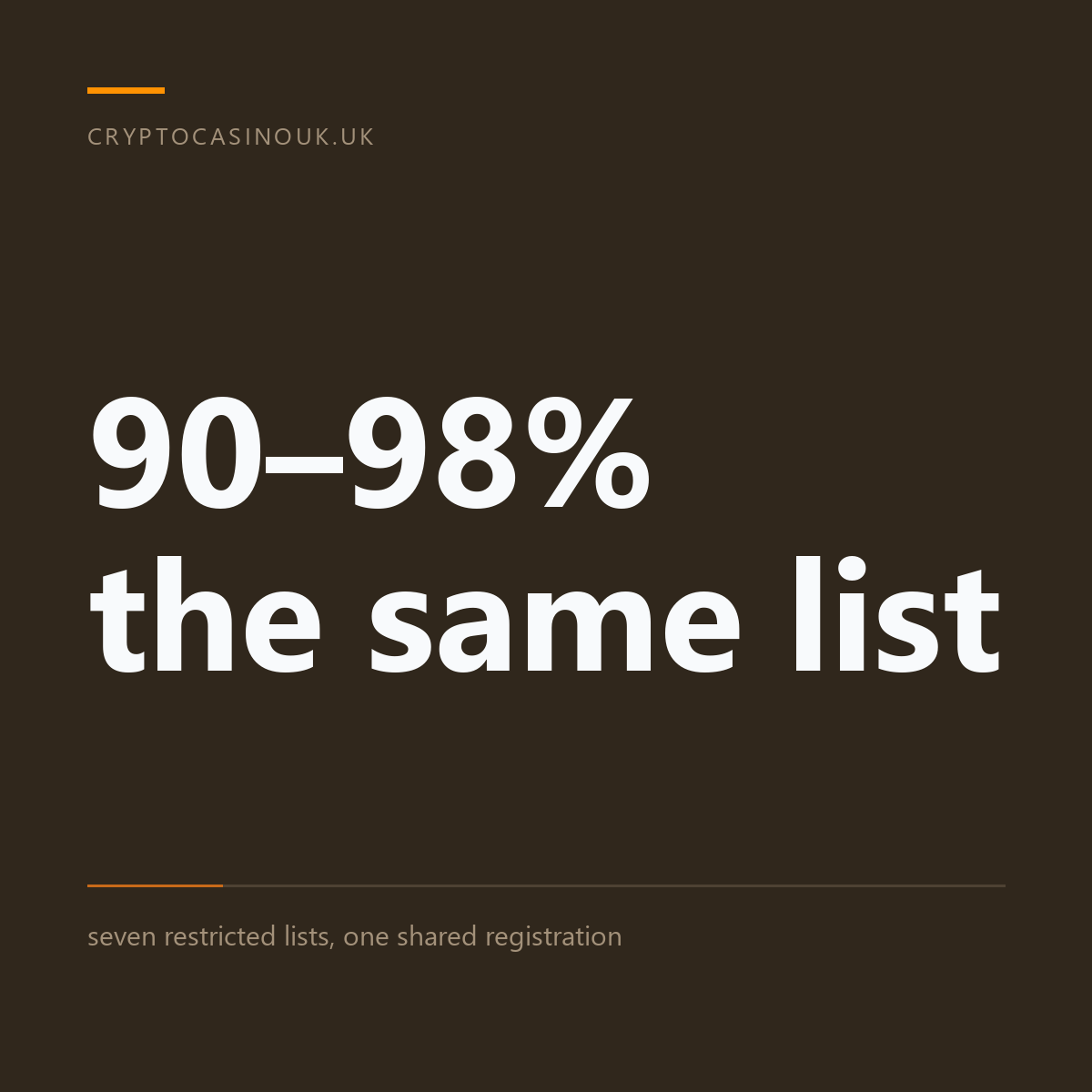
Play the free spinsBecause in several cases it is the same list. A restricted-country list is not usually written brand by brand. It arrives with the licence, and brands sharing one registration number tend to publish very nearly the same set of countries. We read a hundred brands on 26 August 2026. Thirty-eight of them published a restricted-country list at all, and seven of the longest lists overlap with one another by 90 to 98 per cent. The registers explain every one of those overlaps.
That has a consequence worth stating before the numbers. If a list is inherited rather than drafted, then its length measures the compliance sheet behind the licence, not the caution of the operator using it.
One country at one end, 224 at the other
The thirty-eight published lists run from a single country to 224. That is the whole range, and almost nothing sits comfortably in the middle of it. Nineteen of the thirty-eight — exactly half — name thirty countries or fewer. Seven name more than two hundred.
A range like that should make anyone suspicious of the obvious reading. The obvious reading is that a brand naming 224 countries is a cautious operator and a brand naming one is a reckless one. If that were true, the lists would be spread out, because operators are not identical in their caution. Instead they cluster at two ends, which is what happens when a document is copied rather than composed.
The pairs that gave it away
Comparing the long lists against each other, three pairs stood out because the shared portion was so large that coincidence stopped being an explanation.
- Mirax and Oshi Casino — 220 countries in common.
- 7Bit Casino and Mirax — 214 in common.
- Bitdreams and Slotum — 213 in common.
Two independent legal teams, working from different corporate risk appetites in different offices, do not arrive at 220 identical country names. The overlap is the fingerprint of a shared source document, and the next question is simply where that document came from.
The registers say why
The licence numbers the brands print on their own pages answer it. Oshi Casino, PlayAmo, Slotum and Bitkingz all publish the same Anjouan registration, ALSI-202508056-FI2. 7Bit Casino and Mirax both publish the same Curacao record, OGL/2024/1307/0748. Bitdreams publishes 8048/JAZ2019-015, issued under the older Antillephone scheme.
Put the two findings side by side and the picture closes. The brands whose restricted lists match are, on the evidence of their own published numbers, working under the same registration. The list is part of the paperwork that comes with it. Nobody is hiding this: the number sits in the footer, and the same reading produced the brand-by-brand table of crypto casinos UK readers are most likely to meet, with the clause number kept beside every position. It is only that almost nobody reads the number and the list as one object.
Seventy-four entries, twice, for two different reasons
The cleanest case in the whole reading is a small one. CryptoLeo and Nine Casino each publish a restricted list of exactly 74 entries. Seventy-three of those entries are the same country. Both brands publish the same Curacao record, OGL/2024/1267/0760.
BitStarz publishes a list of exactly 74 entries as well. It shares only 48 of them with the other two, because it is a different company working from different paperwork.
That is the whole argument in three sentences. Two lists of identical length can be the same document or two unrelated documents, and the length alone cannot tell you which. Only the overlap can, and only the register explains the overlap. A reader who compares brands by counting country names is measuring the wrong thing with impressive precision.
Length is not strictness
Once the lists are grouped by registration rather than by length, the ranking people intuitively build out of them falls apart. A short list is not a permissive operator and a long one is not a careful operator; each is a copy of whatever sheet came with the licence.
Britain makes the point concretely, because it appears on lists of every size. Winz.io names it at clause 2.14, and adds that a player in breach is owed neither refunds nor withdrawals. Slotum names it at clause 2.4. Wild.io names it at clauses 2.6 and 20.12. Stake names it at clause 14.3, with clause 14.4 making concealment of location a breach in its own right. Vave names it at clause 3.6. Those brands are not alike in size, in age or in list length, and the position they take on a British account is the same.
At the other end, Jackbit restricts seven countries — Russia, Belarus, Lithuania, Georgia, Ukraine, Latvia and Moldova — and takes pounds directly. Thunderpick’s clause 3.2 restricts Curacao, the Netherlands, the United States and the countries on the United Nations and FATF lists, and Britain does not appear in it under any spelling. Bitz holds a 48-country list, and the words “United Kingdom” do not occur anywhere in the 949 KB of its terms. Short lists, and on this one question they read as less restrictive than the long ones. That tells you about the paperwork, not about how either brand treats a payout.
Silence about a country is not an invitation
This is where the finding matters most to a British reader, so it is worth being exact about what the absence of a country name means and what it does not.
Under the Gambling Act 2005 the duty to hold a licence sits on the operator, not on the player. A British resident who plays at an offshore casino commits no offence; what is unlawful is advertising to British consumers and taking their money without a Gambling Commission licence, and that exposure is the operator’s. So a list that omits Britain is not granting anyone permission, because permission was never the list’s job. The clause is a commercial statement about which accounts the operator says it will keep.
The player’s real exposure is contractual and it lives in that same clause, accepted at registration. Where Britain is named, the operator’s own terms describe a balance it says it need not pay — Winz.io’s clause 2.14 puts it about as bluntly as a contract can. Where Britain is absent, nothing has been promised either; the omission is simply the state of a document that was inherited from a licensing scheme rather than written about British players at all.
How to read a list after this
Three habits come straight out of the reading, and none of them takes long.
- Read the registration number and the country list as one document. If two brands print the same number, expect their lists to match, and treat them as one source of evidence rather than two.
- Never treat length as a rating. Seventy-four entries meant two entirely different things across three brands in this reading.
- Search the terms for the country name yourself, in each spelling. Bitz’s 949 KB contains no occurrence of “United Kingdom”; that is a fact about a search anyone can repeat, which is the only kind of fact worth carrying away.
The list-by-list comparison this article draws on is set out separately in restricted-country lists compared, and the wider count of what a hundred brands publish at all — licence numbers, verification wording, accepted coins, withdrawal ceilings — is in what crypto casinos publish.
One limit on all of it. These lists were read on 26 August 2026 and they describe the documents as they stood that day. A contract can be rewritten the day after a snapshot, and a registration can change hands, which is exactly why the number is worth checking against the register rather than taken from the footer alone. Everything above is a reading of published documents, not advice, and not a prediction of how any operator will behave.
The welcome package in full
150% up to 1.5 BTC and 100 free spins first, then 100% up to 1 BTC, 50% up to 1 BTC and 25% up to 0.5 BTC. Weekly cashback runs up to 7%.
Join and claim your bonus