Wilhelmina Coote / Clause-by-clause editor
100 free spins on top of a 150% match
The first crypto deposit at the casino is matched by 150% up to 1.5 BTC and comes with 100 free spins. Crypto in, bonus on top; 18+, terms apply.
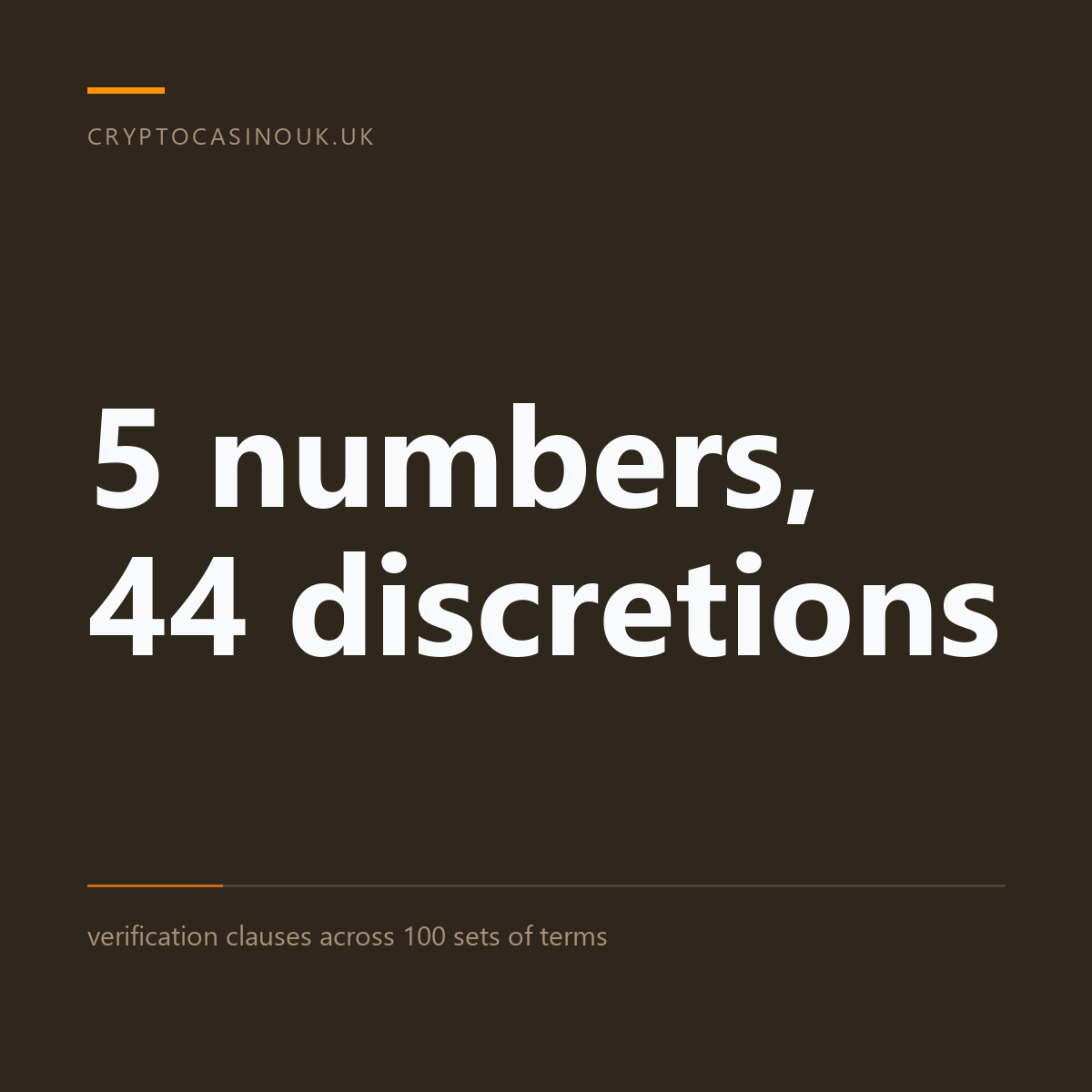
Play the free spinsOut of a hundred crypto casino brands we read on 26 August 2026, five publish the amount at which they will ask for identity documents. Five. Each of those five gives a figure and a clause number, so the statement can be checked against the contract rather than against a landing page. Forty-four other brands publish a verification clause with no figure in it at all.
That is the whole subject of “no KYC” in one line. It is not a fight between casinos that check and casinos that do not. It is a fight between five operators who committed to a number in writing and forty-four who reserved a right and left the number out.
The five that publish a figure
Here they are in full, with the clause each figure comes from.
Two things sit next to that figure. What “anonymous” promises beyond the sign-up form is in what an anonymous crypto casino actually is, and where the coin is held before any of it matters is in the best crypto wallet for UK casino play. The brands whose clauses could be read at all are ranked in best crypto casinos UK.
- Bitcasino.io — €2,500, clause 6.6.
- Sportsbet.io — €2,500, clause 6.6.
- Livecasino.io — €2,500, clause 6.6.
- Rocketpot — 0.05 BTC or $2,500, clause 11.4.
- Empire.io — above 2,000 USDT, clause 5.4.
Five figures, fewer than five decisions
The list is shorter than it looks. Bitcasino.io and Livecasino.io are registered to the same company under one Curaçao licence, OGL/2023/111/0069, and the identical €2,500 figure sits at the identical clause number, 6.6, in both. Sportsbet.io publishes the same figure at the same clause number too. So the five entries represent fewer than five independent judgements about where a threshold belongs; they represent one figure repeated across three brands, two of which share a company and a licence, plus Rocketpot and Empire.io arriving at their own numbers separately.
That does not make the figures worthless. A number in a numbered clause is still the only version of this promise that can be held against an operator later. But it does mean the market has produced roughly three published answers to the question, not five.
What the five is five of
Denominators do most of the work here, so it is worth being exact about them. We read a hundred brands. Forty-nine of them publish a verification wording we could read at all. Of those forty-nine, five name a figure and forty-four do not. The remaining fifty-one publish nothing on the subject that we could find, which is a different situation again and not a reassuring one.
The same pattern runs through everything these brands publish: 68 of the hundred print a licence number, 38 publish a restricted-country list, 30 name the coins they accept, and 14 publish a withdrawal ceiling. All four of those basic facts appear together at 13 brands. At 27 brands, none of the four appears at all. That breakdown is set out in our count of what a hundred brands actually publish. Against that background, five published thresholds is not a small number because operators are secretive about identity specifically. It is small because publishing anything checkable is the exception. Every brand behind these counts, with the verification clause quoted beside it, sits on our Bitcoin casino UK comparison page.
What a discretion clause actually says
The forty-four clauses without a figure are not vague by accident, and they are not empty. They say the operator may request identity documents at any time, at its own discretion, and may suspend the account until those documents arrive. Read that carefully and the meaning is not “we will not ask you”. The meaning is “we may ask you whenever we choose, and you agreed to this at registration”.
A threshold and a discretion behave differently in exactly one respect, and it is the one that matters. A threshold tells you in advance which side of a line you are on. A discretion tells you nothing in advance, because the trigger is a decision rather than an amount. Marketing that calls both of them “no KYC” is describing the sign-up form, which is the same in both cases, and skipping the clause, which is not.
No KYC describes the front door, not the exit
The withdrawal request is where these clauses get used, because it is the first point at which the operator has a reason to use them. Nine Casino says so directly: it does not process a payout until the account has been fully verified. Most brands leave the same sequence unstated, but the clause is there to be exercised at the same moment.
Once it is exercised, the clocks that exist run against the player. Rocketpot, clause 11.4, allows thirty calendar days to supply documents. Bets.io, clause 5, says as a rule thirty days, with the account frozen until they are received. Slotum, clause 13, closes an account if the player cannot be reached within two weeks of a withdrawal request, and Playbet.io does the same in clauses 13.4 and 13.8. Not one contract we read gives the operator a deadline for reviewing what it was sent. We looked at that asymmetry on its own in our piece on what stands in front of a payout.
So the honest version of the phrase is narrow. “No KYC” reliably describes what happens when you arrive. It describes nothing about what happens when you leave with a balance.
One account we used rather than read
Everything above comes from documents. One thing on this site does not. At Vave we deposited our own money and withdrew it, and both the deposit and the payment were made and received on 28 August 2026. That is a single transaction pair at a single brand on a single day, and we describe it that way because that is all it is. It settles nothing about verification thresholds and it is not evidence about any other operator.
Vave is also a good illustration of why the documents deserve more weight than the experience. Its clause 3.6 names the United Kingdom among the restricted countries, and no regulator is named anywhere on its site. A withdrawal that arrived does not amend a clause that says the operator did not want the business in the first place.
What this means for a British reader
Gambling in Britain is regulated by the Gambling Act 2005, and the duty to hold a licence sits on the operator, not on the player. A British resident who plays at an offshore casino commits no offence. What is unlawful is advertising to British consumers and taking their money without a Gambling Commission licence, and that exposure belongs to the operator. This is how the rule is built; it is not legal advice, and this site does not give any.
The risk that lands on the player is contractual instead, and it is written in the restricted-countries clause accepted at registration. A verification clause and a restricted-countries clause can be used together at the same moment, which is why a threshold on its own never answers the question for a British account.
One brand in this reading holds a Gambling Commission licence: Rollbit UK, number 057869-R-334655-009. That licence is what puts GamStop, deposit limits and a defined complaints route behind an account, since GamStop covers accounts with operators licensed by the Gambling Commission. It also comes without crypto deposits, which is the trade in plain terms.
What would settle it
A published figure with a clause number is a low bar, and forty-four operators with a readable verification clause did not clear it. Two things would close the gap, and neither requires anyone to change how they check identity: a stated amount above which documents are requested, and a stated period within which the operator will finish reviewing them.
Until then, the useful question is not whether a brand calls itself no-KYC. It is whether it has written down anything you could hold it to. On 26 August 2026, five out of a hundred had.
The welcome package in full
150% up to 1.5 BTC and 100 free spins first, then 100% up to 1 BTC, 50% up to 1 BTC and 25% up to 0.5 BTC. Weekly cashback runs up to 7%.
Join and claim your bonus