Wilhelmina Coote / Clause-by-clause editor
100 free spins on top of a 150% match
The first crypto deposit at the casino is matched by 150% up to 1.5 BTC and comes with 100 free spins. Crypto in, bonus on top; 18+, terms apply.
Play the free spinsThere is no best crypto wallet for everyone in Britain, and the honest form of the answer is a decision rather than a ranking. What settles it is not a brand name but one fact about your own money: whether the coin is sitting still or moving. Coin that sits still belongs behind a key nobody else holds. Coin that moves this week — into a deposit, back out again a few days later — belongs somewhere convenient enough that you will handle it correctly under mild pressure.
Everything below follows from that. Three storage models, what each one costs when something goes wrong, and where the wallet question stops and the casino question starts. Anyone naming a single best wallet for every reader is selling something, and usually the thing they are selling is the link.
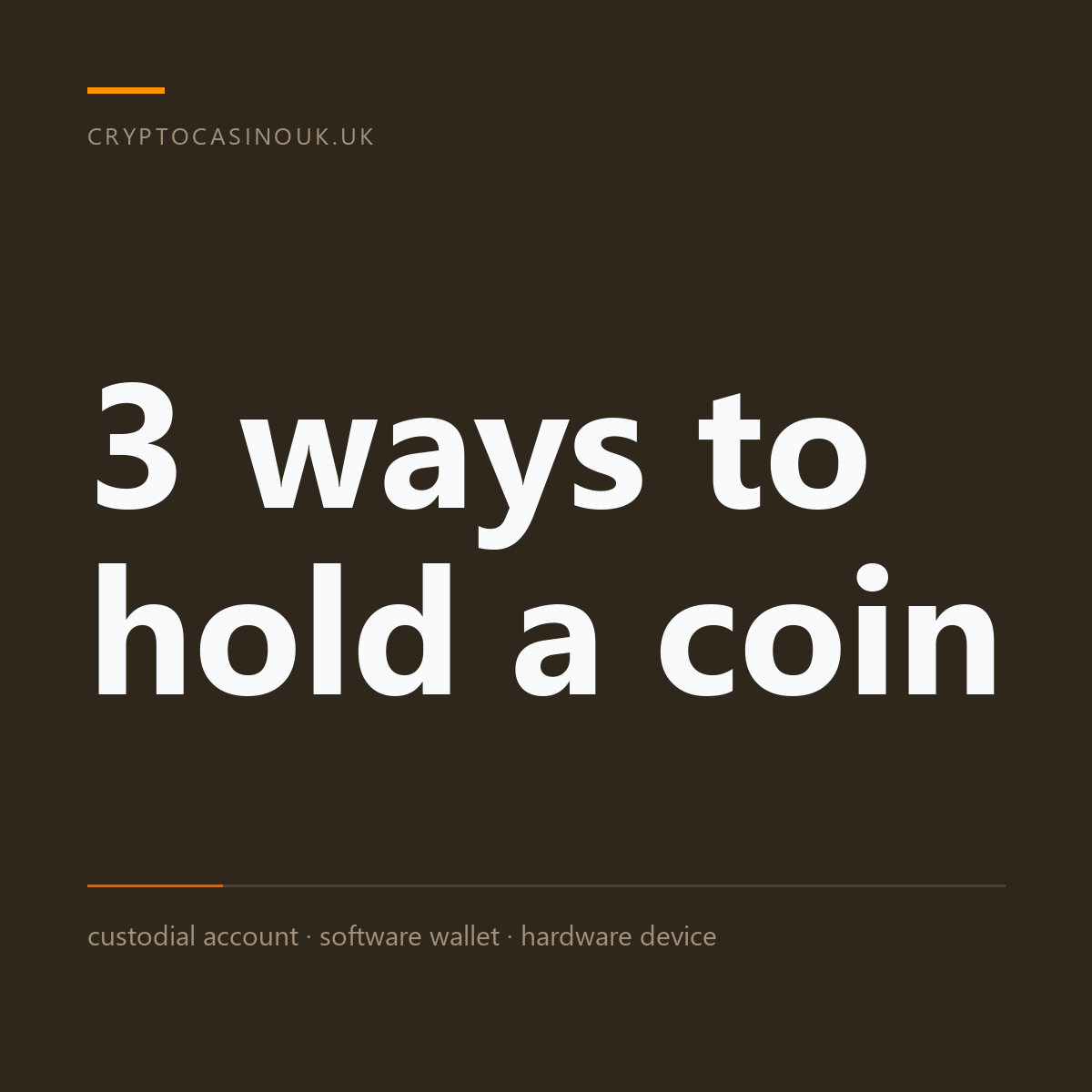
Three storage models, and who holds the key
The industry uses a lot of words for what is really one question: who can move the coin without asking anyone. There are three practical answers.
A wallet is the second decision of three. The first is turning pounds into coin, covered in how to buy crypto in the UK; the third is how fast that coin then moves at a casino, in crypto casino payment speeds. The operators whose deposit and withdrawal terms we have read are ranked in top crypto casinos UK.
An exchange account
The exchange holds the key and you hold a login. This is custody, not a wallet, whatever the app calls it. The practical consequences are worth stating plainly: the company can freeze the balance, it can ask for documents before it releases anything, and its own terms decide what happens if it fails. Against that, a forgotten password is a support ticket rather than a permanent loss, and that is a genuine advantage for people who have never managed a key.
An exchange account is also where most British buyers start, because it is where pounds turn into coin. Starting there is fine. Ending there, with a balance that never moves, is a decision you should make on purpose rather than by default.
A software wallet on a device you own
Here the key sits on your phone or laptop and nobody else can move the coin. Nobody else can recover it either. A software wallet is fast, free, and appropriate for the amount you are prepared to lose to a broken phone or a careless moment. It is the sensible home for money that is in motion — the balance you are about to deposit, and the balance that came back out.
The risk here is not exotic. It is the ordinary one: a device that gets stolen, an app installed from the wrong place, a recovery phrase photographed for convenience. The security model of a software wallet is the security model of the machine it is sitting on, and most people do not think about their phone that way.
A hardware wallet
A separate device holds the key and signs transactions without the key ever reaching the computer. It costs money, it is slower to use, and it is the right answer for a balance you intend to leave alone. It is the wrong answer for a balance that moves twice a week, because friction is the point of it, and friction applied to routine transfers just produces mistakes.
The question that actually decides it
Ask whether this particular pot of coin is sitting still or moving, and the choice makes itself.
- Money you are keeping and not touching: hardware wallet, recovery phrase written down and stored somewhere a house fire would not reach.
- Money you are moving in and out over days or weeks: software wallet on a device you control, holding only what you can afford to lose.
- Money you have just bought and are about to send onward: an exchange account is where it already is, and moving it to an address you control is the next step rather than a separate project.
Most people need two of these at once, not one. The mistake is not choosing the wrong brand; it is treating one wallet as the answer to two different jobs.
Where a casino withdrawal should land
A withdrawal needs an address, and the address is the one part of this that cannot be undone. A transfer sent to the wrong address is not reversed by a support ticket, and no operator’s terms undertake to recover it. That argues for a withdrawal address you can produce without hurrying, from a wallet you open often enough to recognise.
It is also worth separating two delays that get blamed on each other. A transfer that has been sent settles on the chain in its own time, and that time is usually short. The part that takes longer sits in front of it, in the operator’s own approval step, and that step is governed by the contract you accepted at registration rather than by the network. We have set out separately what stands in front of a payout, because it is not the wallet’s doing and choosing a different wallet will not change it.
A wallet decision is also easier once you know which brands will take a British account at all. That is the work the rest of this site does: it reads the terms of every Bitcoin casino UK players are likely to meet, and prints the clause number beside each position it reports.
A forgotten password and a lost recovery phrase are different losses
This is the distinction that catches people, and it is worth being blunt about it. On an exchange, a forgotten password is an inconvenience: the company still holds the key, and there is a process, usually involving documents. In a wallet you control, the recovery phrase is the money. Lose it and there is no process, no appeal and no support desk with a copy, because the design of the thing is that no copy exists.
That cuts both ways, and it is exactly why the sitting-still-or-moving question matters. Self-custody removes one party who could freeze your balance and replaces them with your own record-keeping. For some readers that is a clear improvement. For others it honestly is not, and pretending otherwise would be dishonest advice dressed up as principle.
Where British law puts the duty
Gambling in Britain is regulated by the Gambling Act 2005, and the duty to hold a licence sits on the operator, not on the player. A British resident who plays at an offshore casino commits no offence by doing so. What the Act makes unlawful is something the operator does: advertising to British consumers and taking their money without a Gambling Commission licence.
The player’s exposure is a different kind. It is contractual, and it is written into the restricted-countries clause accepted at registration — the clause under which an operator can say a balance need not be paid. No wallet changes that, in either direction. Where your coin is stored has nothing to do with which contract you have agreed to, which is why the wallet question and the casino question should be answered separately and in that order.
Two tax rules, held apart
Gambling winnings are not taxed in Britain. That is the rule people remember, and it is correct as far as it goes. The rule people then skip is the second one: cryptocurrency is treated as property for capital gains purposes, so selling a coin or swapping it for another can be a chargeable event on its own footing, whatever the coin’s origin.
Those are two separate rules about two separate acts — winning, and later disposing of what you won. Conflating them is where readers go wrong in both directions, either assuming everything is taxable or assuming nothing is. This is a description of how the rules are structured, not tax advice; anything specific to your own position belongs with HMRC or an accountant, and this site does not pretend to stand in for either.
What this site rates, and what it does not
We read casino terms and print the clause number next to what we found. We do not rate wallets, we hold no commercial arrangement with any wallet maker, and there is no ranking behind this article for the same reason there is no winner named in it: the right answer changes with what the coin is doing, and a table would only hide that. How the reading is done, and what we will not claim, is set out in how this site works.
If you want one sentence to act on: keep the balance you are not using behind a key you control, keep the balance you are using small, and spend the attention you saved on reading the contract at the other end of the transfer. That contract is the part with a clause number, and it is the part that decides whether the money comes back.
The welcome package in full
150% up to 1.5 BTC and 100 free spins first, then 100% up to 1 BTC, 50% up to 1 BTC and 25% up to 0.5 BTC. Weekly cashback runs up to 7%.
Join and claim your bonus